

The Pre-K years are a time of emerging curiosity in children; they notice the activities happening around them such as waking up each morning, getting ready for school every day, playing after school each day, taking their naps every afternoon, then going home after school, having a meal and getting ready for bed each night.
Children at this age will start to associate the same activity taking place on different days with its corresponding day name. When you teach children to recognize what day it is, you’re helping them not only to remember the name of each day but: to become familiar with how to use the word “day” when talking about their daily lives; to have an understanding of their daily and weekly routines; and, to build their vocabulary. When combined with proper instructional strategies, this type of learning can be engaging and rewarding for both you and the child.
Reasons Why it is Important to Learn the Days of the Week
- feel like they know what is going to happen next.
For example, Monday could mean School Time, Wednesday might be when their art class is scheduled, Saturday may be when they have Family Experiences.
- Knowing what Activities occur on what Days assist with giving kids a sense of order and Confidence.
- Learning the Days of the Week also supports the development of Early Math Skills in children. Things like sequencing, recognizing patterns and developing memory are all going to increase as children learn the Days of the Week.
- Additionally, as children learn the Days of the Week, they develop a better understanding of language when used properly; therefore, they will begin to use the terms “Today”, “Yesterday” and “Tomorrow” properly.
Begin With a Tune
Children at preschool age enjoy music and songs are a great way to help them remember new ideas and concepts. Every morning before class starts is the perfect opportunity to sing a happy song called “The Days of The Week.” You may find many different versions of this song on the Internet to use as a guide or you could easily create your own. To make the experience even more fun, ask the children to clap, snap, or tap along with the beat.
The routine of singing this song daily will help children to practice singing the days of the week and memorize them without having to feel like they are in a class. Before long you will see your children confidently singing the days of the week aloud.
Use Visual Aids
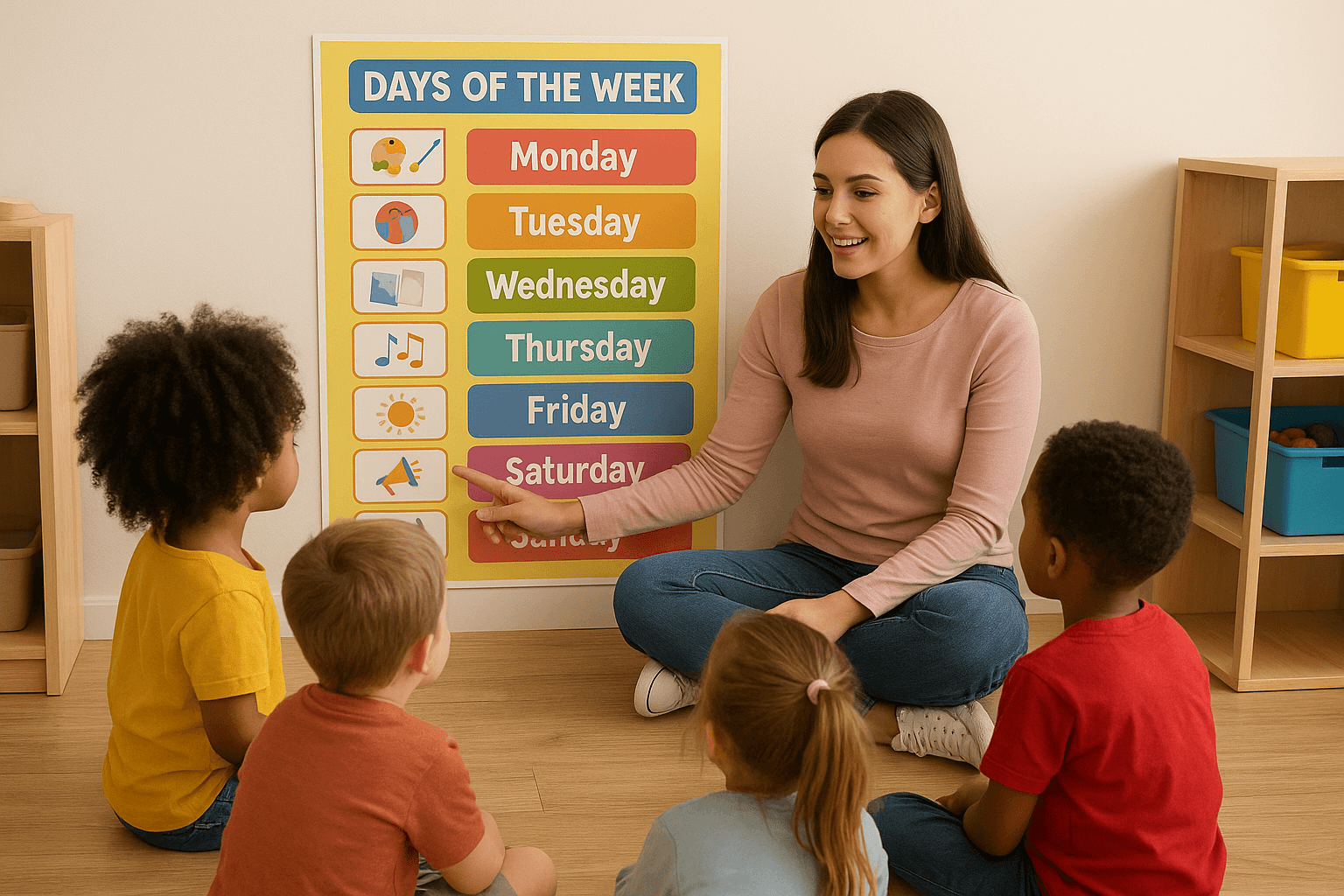
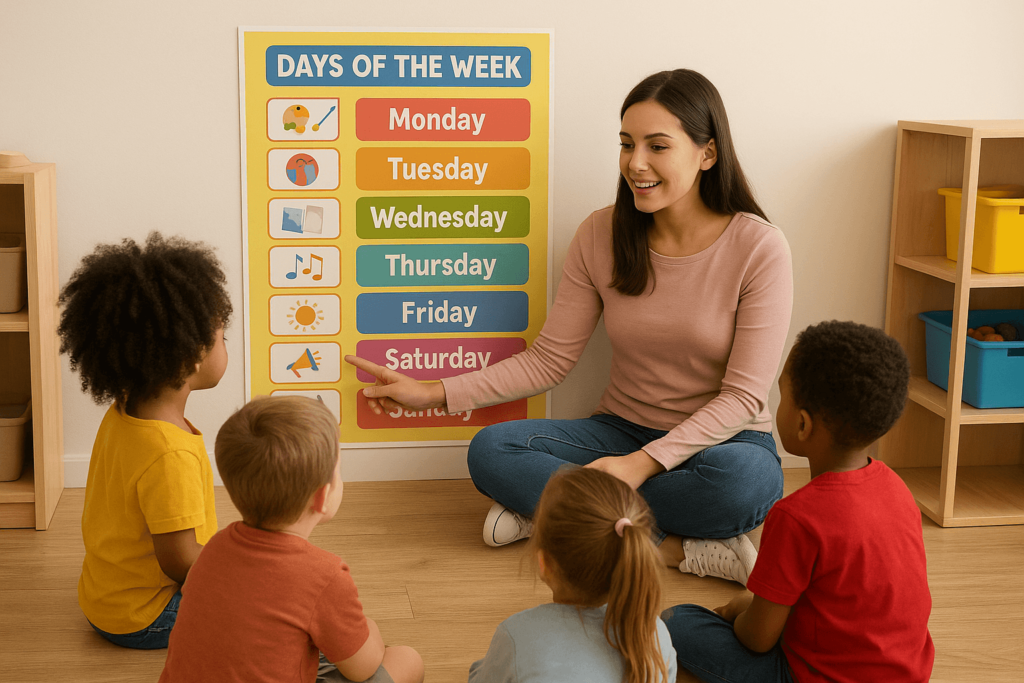
Young children learn through visual and tactile experiences. Having a colorful chart of the days of the week hanging in the classroom is a great way to help with their learning and retention. Your chart should have colorful graphics and illustrations as well as large print letters. You may also want to add pictures that illustrate your daily schedule. For instance, you may want to add images that represent the following activities to represent the days of the week:
- Monday: Crafting
- Tuesday: Outdoor Play
- Wednesday: Library Visit
- Thursday: Music & Dance
- Friday: Show & Tell
- Saturday & Sunday: Family Time
When children can visually connect a day of the week with a specific activity, the learning experience becomes more meaningful and more likely to be retained.
Additionally, you can use flash cards or make a “Day Wheel” that the children can spin each morning to indicate the day.
Incorporate Days of the Week into Real-World Activities
Children learn best when you incorporate real-world experiences into their learning. Talk to your children about each day during morning circle time:
On Monday, you can talk to your children about what they do on Mondays.
You can also ask your child about what they look forward to on Tuesday when you tell them that Tuesday is coming tomorrow.
You can ask your child about fun activities that they did at home last Sunday when you mention that Sunday was yesterday.
This type of discussion allows children to understand what each day means beyond simply its name. It encourages them to start thinking of the concept of time, how daily routines relate to each other, and how weeks are divided up.
Use Stories to Teach Children About the Days of the Week
Stories are a powerful teaching method. Create a series of simple, short stories that feature the days of the week in order. For instance, you could write a story about a bunny doing different fun things every day of the week: on Monday, he bakes; on Tuesday, he gardens; on Wednesday, he paints, etc.
You can also read popular children’s picture books that discuss the days of the week and the various activities associated with each day. Hearing these stories repeatedly will help children learn the order of the days and make it easy for them to remember them.
Interactive Ways to Reinforce Learning
Interactive and hands-on learning is a great way for kids to have fun while they learn. Below are some great ideas for creating a fun environment for active learning.
1. Days of the Week Sorting Game
Help your students learn the order of the days of the week with the everyday use of the “sort by”, “days of the week” phrase. Create a set of cards with each day on them, and have the children arrange them into the correct order, based on when they happen. You could also provide some assistance in the form of color-coding the days or providing small images as clues.
2. Weekly Routine Collages
Create a weekly routine collage using images of the activities students perform on each day of the week. You will build creativity in your students, while reinforcing their knowledge of what they do each day.
3. Calendar Time
Introduce the classroom calendar in the class to incorporate the routine of the calendar into your students’ daily lives. Each day in the morning, pick one of your students to change the calendar from one day to the next. This helps create a sense of ownership with their progression through time and also helps establish a routine for them to learn.
4. Days of the Week Acting Activities
Incorporate small acting games into your classroom activities. For example, when it is Monday, students could pretend to pack their school bags; when it is Tuesday, they could act out a story, etc. Students are taught to associate fun with learning by creating a fun atmosphere; and through the use of these games, they will remember learning more easily.
Make learning continuous
Preschoolers are learning through action. Use these activities; for example, during snack time, while your students are playing outside, and during transition times. While your students are going through their routines, repeatedly asking questions about the days of the week, such as “What day do you think it is tomorrow?” or “What did we do yesterday?” will aid in establishing the days of the week in their brains.
Recognizing Success Each Week
Every week, parents can acknowledge their children’s accomplishments through the organization of a special event. For example, at the end of each week, a “Days of the Week Parade” can be created where children hold placards representing each day of the week or as a simple fun quiz where children can point to the correct day on a chart. By holding these types of events, parents are helping their children build self-esteem while also inspiring them to look forward to the next week.
